

1600s
-
1619 August 23 & 26
Two Dutch-flagged, English-owned privateers arrive at Old Point Comfort, Virginia and trade 20 Africans for food and water. These ships, Treasurer and White Lion, had captured ‘20 odd negroes’ from the Portuguese slave ship Sao Joao Bautisa off Vera Cruz, Mexico. These captured souls were from the Kingdom of Ndongo, now part of Angola
-
Thirty-two Africans live in Virginia.
-
Antonio Johnson, from Angola, arrives in Virginia.
-
Antonio Johnson is released from his indenture and moves to Northampton County on Virginia's Eastern Shore.
-
Isabella, the wife of Antonio Tucker, gives birth to a son. They name him William in honor of their master Captain William Tucker, a member of the House of Burgesses and commander of fortifications at Old Point Comfort. The child William is baptized. There is no record of his status being either free or indentured.
-
Twenty-three people of African descent are living in Virginia.
-
The Dutch West India Company transports 11 African men into the New Netherlands (New York)
-
The New Netherlands forbids citizens from harboring or feeding runaway enslaved people.
John Punch, an indentured servant of African descent, escapes from his enslaver, Hugh Gwyn, along with two white servants. They are captured, convicted, and sentenced. The indenture contracts of the two white servants are extended by four years. The court decided that ‘the third being a negro named John Punch shall serve his said master or his assigns for the time of his natural life here or elsewhere.’ This ruling is the first legal action documenting slavery in Virginia.
-
Massachusetts is the first English colony to establish slavery.
-
Three hundred persons of African descent now live in Virginia.
-
Anthony Johnson imports five servants, three of whom are white and two of whom are African. He is granted 250 acres as ‘headrights.’
-
One of Johnson’s servants was the “negro known as John Casor.” Casor claims he had indentured himself to Robert Parker upon the end of his indenture with Johnson. Johnson sues Parker for the return of Casor. The Northampton County court ruled that Parker had ‘most unjustly keepeth the said negro from his master.’ Casor is returned to Anthony Johnson as his servant for life.
-
The Virginia General Assembly enacts a law that if an Englishman should run away with “any negroes” he will serve the time that the “negroes” are away from their masters.
-
Virginia passes a law that the children of African-descended women will serve based on the condition (enslaved or free) of the mother.
-
Maryland legalizes slavery.
-
1663 September 1
Plant-Cutter Riots (also known as Indentured Servant’s Plot or Gloucester County Conspiracy)
The lives of indentured servants were extremely difficult. These individuals were a key component of the tobacco industry; yet, their living conditions, food, and backbreaking work were often inhumane. African convicts, Oliverian soldiers from the English Civil War, and Virginia Indian servants worked together in the fields and frequently attempted to run away.
William Bell and John Gunter, disaffected servants and veterans of Cromwell’s army, gather several followers and meet at a house owned by Peter Knight. There, they plot a revolt to raid local plantations, secure more supporters and weapons, and disrupt the harvest season. Ultimately, they plan to coerce Governor William Berkeley into improving working conditions.
1663 September 6
John Berkenhead, a servant of Major John Smith, reveals the plot to Virginia officials. They set an ambush for the conspirators and sprung it near Poplar Branch, a tributary of the Poropotank River. Nine rebels are captured.
1663 September 13
Four of the leaders are hanged. Berkenhead is given his freedom and 5,000 pounds of tobacco in recognition of his loyalty to the colony.
-
New York and New Jersey legalize slavery.
Maryland outlaws marriage between white women and Black men.
-
Maryland passes a fugitive slave law.
-
Virginia enacts a law detailing that Christian baptism will not alter a Black person’s status as a slave.
-
New Jersey passes a fugitive slave law.
-
Virginia General Assembly law states that if an enslaved person resists his enslaver and is killed during his punishment, the owner is not to be charged with a crime.
-
Virginia prohibits free Blacks and Indians from keeping Christian white servants.
-
Two thousand persons of African descent now live in Virginia.
-
King Charles II of England encouraged the Royal African Company to expand the English slave trade. Within 16 years, the company transports 90,000 Africans to the Americas.
-
New York enacts a law that Blacks who convert to Christianity after their enslavement will not be freed.
-
Three thousand Africans live in Virginia.
Virginia General Assembly passes an act to prevent “Negro Insurrections,” making it unlawful for enslaved Africans to carry guns or any other type of weapon, or to leave their enslavers’ property without a certificate. No white man or woman could marry a person of African descent, nor could an enslaved person resist punishments levied by their enslaver.
-
Virginia declares that all imported Black servants are enslaved people for life.
-
Pennsylvania Quakers pass the first formal anti-slavery resolution.
Aphra Behn, a successful female English playwright, poet, and essayist, published a mythical tale entitled Oroonoko, or, The Royal Slave. The book was one of the first novels written in English and drew attention to the evils of slavery.
-
Virginia outlaws marriages between whites and Blacks, and whites and Native Americans.
Virginia forbids the manumission of enslaved people in the colony. Formerly manumitted Black people are forced to leave the colony.
-
The Royal African Company's monopoly on the slave trade comes to an end. England becomes the largest slave trader.
1700s
-
16,390 Africans live in Virginia.
Pennsylvania legalizes slavery.
-
Connecticut assigns the punishment of whipping to any enslaved person who disturbs the peace or assaults whites.
-
Enslaved Africans are considered real estate. An enslaver is not to be punished for wounding, maiming, or killing an enslaved person. No minister of the Church of England is to marry a white man or a woman and a person of African descent.
-
The State of Connecticut requires that Indians, mulattos, and Black servants gain permission from their masters to engage in trade.
-
Rhode Island requires that enslaved people be accompanied by their masters when visiting the homes of free persons.
Blacks outnumber whites in South Carolina.
-
New York forbids Blacks, Indians, and mulattos from walking at night without lighted lanterns.
-
Pennsylvania and Rhode Island prohibit the importation of Blacks and Indians.
-
New York forbids free Black, Indian, and mulatto enslaved persons from owning real estate or holding property.
Pennsylvania prohibits the importation of enslaved people.
1712 April 6
New York City Slave Revolt
By the early 1700s, twenty percent of New York’s population was of African descent. Slave codes were established during this time to control the enslaved population, such as prohibiting the gathering of more than three enslaved persons and segregating them in churches. This circumstance prompts about 20 enslaved persons to set fire to a building on Maiden Lane near Broadway. As the white New Yorkers try to put out the fire, the enslaved Blacks, armed with guns, hatchets, and swords, attack the whites and then run away. All of the runaways are returned to their owners. The city’s government captures 70 Black people. Of these, six purportedly committed suicide and 27 are placed on trial. Twenty of these enslaved people are burned at the stake, including a pregnant woman. Another is executed on a breaking wheel.
-
Rhode Island legalizes slavery.
Maryland passes a law stating that all bondsmen and their descendants entering the colony are enslaved people for life.
-
New York passes a Fugitive Slave Law.
-
26,559 Africans live in Virginia.
The number of Africans imported into the English colonies increased to 45,000 per year by 1720.
-
Virginia makes illegal manumission of enslaved persons.
-
30,000 Africans live in Virginia.
-
Spanish officials declare that bondsmen fleeing from the British colonies to Florida are not to be returned to their enslavers. These escaped bondsmen had to convert to Catholicism to remain in Spanish Florida.
-
Rebellious enslaved persons being transported on a vessel commanded by Captain John Major of New Hampshire overtake the ship, killing the captain and crew.
-
Quaker Elihu Coleman publishes “A Testimony Against That Anti-Christian Practice of Making Slaves of Men.”
1733 November 23
St. John Slave Insurrection
Breffu, an enslaved Akwamu woman from Ghana, kills her enslavers and begins a revolt that, by early 1734, takes control of the Danish island colony, St. John. The insurgents’ plan is to rule the island while continuing crop production. Most of the 20 white planters were killed, but a few escaped, securing assistance from Martinique.
-
1734 April 23
French troops arrive on St. John in response to the slave Insurrection. By May 27, the Danish settlers on St. John regain control of the island. Breffu and several of her followers commit suicide rather than facing capture.
-
Georgia prohibits the practice of slavery.
-
Georgia permits the importation of enslaved persons.
Spanish Florida reinforces the granting of freedom and land to runaway slaves.
-
1739 September 9
The Stono Rebellion (also known as Cato’s Rebellion)
Jemmy, a literate enslaved man, organizes a rebellion in South Carolina. He led 20 mostly Catholic Kongolese bondsmen in an armed march toward Spanish Florida to secure their freedom. The Spanish Colonial government had issued several proclamations that offered fugitive slaves freedom if they converted to Catholicism and served in the Florida militia.
En route, Jemmy recruits another 60 enslaved individuals moving south from the Stono River. Their ‘flag’ is marked ‘Liberty.’Their first killings are at Hutchinson’s Store at the Stono River Bridge. As they moved further south, they burned six plantations and killed about 25 whites.
Lieutenant Governor William Bull rallies enslavers, and this well-armed, mounted militia attacks Jemmy and his command at the Edisto River. The ensuing battle resulted in the deaths of 23 whites and 47 enslaved individuals. Although defeated, they continued to move south, and the rebellious bondsmen were captured by white militia and executed or transported to the West Indies.
-
60,000 persons of African descent live in Virginia.
In response to the Stono Rebellion, South Carolina passes the “Negro Act,” which prohibited enslaved people from assembling in groups, raising food, earning money, or learning to speak English.
-
Servant Conspiracy of 1741
New York City has the highest number of enslaved persons, after Charleston, SC. The Stono Rebellion, two years earlier, had prompted many bondsmen and poor whites to plan a rebellion because of their poor economic conditions. A series of 13 fires erupted in the city between April and May 1741. Mary Burton, a sixteen-year-old Irish girl, was arrested for having stolen goods. Burton told the officials about the conspiracy, and they arrested hundreds of enslaved persons, free Blacks, and poor whites. The leaders, the slave Ceasar, and white tavern keeper John Hughson, were gibbeted, their bodies left to rot on public display. Thirty-four others were executed.
Thirteen Blacks were burned at the stake. Another 17 Black men, two white men, and two white women were hanged. Seven other whites were pardoned, yet they were expelled from New York.
-
1743 May 20
Haitian general Toussaint L’Ouverture is born.
-
Pennsylvania Quakers forbid their members from owning chattel property or participating in the slave trade.
-
“Observations on the Enslaving, Importing and Purchasing of Negroes,” by Anthony Benezet, is printed in Germantown, Pennsylvania, and was the first anti-slavery work published in the English North American colonies.
-
New Jersey prohibits the enlistment of enslaved persons in militia units without their enslaver’s permission.
-
Denmark Vesey (Telemaque) is born into slavery in St. Thomas, Virgin Islands. His enslaver, Captain Joseph Vesey, moves Denmark to Bermuda and later to Charleston, SC.
-
Ukanosaw Gronniosaw, also known as James Albert, published his autobiography, A Narrative of the Most Remarkable Particulars in the Life of James Albert Ukanosaw Gronniosaw, the first slave narrative published in Great Britain.
-
The first segregated Black church in the English colonies is founded in South Carolina.
Phillis Wheatley becomes the first published African American author when a London company publishes a book of her poetry.
Slaves in Massachusetts unsuccessfully petition the state government for their freedom.
-
The First Continental Congress vows to discontinue the slave trade after December 1.
Connecticut, Rhode Island, and Georgia prohibit the importation of slaves.
-
210,000 people of African descent live in Virginia.
The slave population in the English colonies reached 500,000. In Virginia, the ratio of free colonists to bondsmen is nearly 1:1. In South Carolina, it is approximately 1:2.
The founding of the Pennsylvania Society for Promoting the Abolition of Slavery is the world’s first anti-slavery society and the first Quaker anti-slavery society. Thomas Paine and Benjamin Rush join the society. (Later, in 1787, Benjamin Franklin becomes a member.)
When he first assumed command of the Continental Army, General George Washington prohibited the enlistment of free Black people and enslaved people. He rescinded this order and enabled the mustering of free Black soldiers.
1775 November 7
Dunmore’s Proclamation
Virginia Governor Lord Dunmore proclaims that African-descended slaves could run away and join the British Army. Between 800 and 2,000 enslaved persons join the Ethiopian Regiment under Dunmore’s command.
-
1776 July 10
Lord Dunmore abandons his base on Gwynns Island, Virginia, after the July 8-9 Battle of Crocket Hill. Dunmore takes approximately 300 people of African descent with him as he leaves Virginia forever.
-
Virginia makes the importation of slaves illegal.
-
1779 June 30
Philipsburg Proclamation
General Sir Henry Clinton issues a proclamation stating that all slaves belonging to American patriots are to be considered free and are welcome within British lines. (Eventually, the British resettled 3,000 formerly enslaved persons to Nova Scotia, while others went to Sierra Leone, where they established Freetown.)
-
Delaware prohibits the enslavement of imported Africans.
Pennsylvania begins gradual emancipation.
-
Virginia encourages manumission.
-
An estimated 2,000 free Blacks live in Virginia.
-
Virginia emancipates slaves who served in the Colonial forces against Great Britain.
Maryland prohibits the importation of African slaves.
-
Rhode Island and Connecticut begin a gradual process of emancipation.
North Carolina prohibits the importation of Africans.
-
Virginia states that any person with black blood to be a mulatto. The term ‘negro’ includes any references to mulattos.
The New York Manumission Society is founded.
-
The Northwest Territory Ordinance outlaws slavery within its territory.
Black Preacher Richard Allen founded the African Methodist Episcopal Church in Philadelphia, Pennsylvania.
Rhode Island outlaws citizen participation in the slave trade.
North Carolina levies a prohibition tariff on imported African slaves.
-
New York passes a new comprehensive slave law confirming that all slaves are slaves for life.
Connecticut and Massachusetts from participating in the slave trade.
-
The Maryland Society for promoting the Abolition of Slavery and the Relief of Free Negroes and others unlawfully held in bondage is organized in Baltimore.
The Interesting Narrative of the Life of Olandah Equiano, or Gustavus Vassa, is published in Great Britain. It proved to be a popular slave narrative, with nine editions printed. The work is among the earliest slave narratives. Vassa details the slave trade as a harsh and inhumane practice. He became a sailor, and his travels gave him great insights, which he shared in his writing. His book became popular and helped strengthen the growing English abolitionist movement.
The Pennsylvania Abolition Society is founded.
-
U.S. Congress denies naturalization to anyone who is not a free white.
-
Benjamin Banneker, an astronomer and mathematician, becomes the first Black to publish an almanac.
1791 July 9
Pointe Coupee Slave Conspiracy
Slaves on the estate of Widow Robillard in New Roads, Pointe Coupee Parish, Louisiana, plan an insurrection. They were prepared to launch on 7 July 1791, yet bad weather delayed the revolt until 9 July. By that time, Venus, an enslaved woman, had passed word of the planned insurrection to her enslaver, George Oliveau, who spread the news onward to the local militia. Seventeen slaves were arrested and sent to New Orleans for trial. Since the Spanish government lacked sufficient interpreters, 16 enslaved people were returned to Pointe Coupee Parish; one committed suicide.
1791 August 21
Haitian Slave Revolution
The enslaved people of the French colony of Saint-Domingue (Haiti) rose in revolt. It became the largest slave revolt since Spartacus’s failed rebellion against the Roman Republic. The news of this successful uprising prompted enslaved people in the Americas to follow suit, in an attempt to gain their freedom. The revolt progressed through several phases, culminating in Haiti’s establishment as an independent sovereign state.
-
Freetown, Sierra Leone, in West Africa, is founded by more than 1,000 former slaves freed by the British during the Revolutionary War.
-
Eli Whitney invents the cotton gin, allowing the expansion of slavery westward.
1793 August 29
The French Republican Government emancipates all enslaved people in Saint Domingue (Haiti).
-
The U.S. Congress prohibits the slave trade between the United States and other foreign powers.
The first independent Protestant Black churches in the United States are St. Thomas African Episcopal Church, founded by Absolom Jones, and Bethel Church, founded by Richard Allen. Both were located in Philadelphia, Pennsylvania.
-
1795 May 4
The Spanish Colonial government, following the 9 July 1791 Pointe Coupee Slave Conspiracy, dictated that enslavers provide people held in bondage with better living conditions. This did not stop three white men and 57 Black men from planning another uprising on the plantation of Julien de Lallande Poydras.
On May 4, these insurgents are were put on trial. Twenty-three Blacks are hanged, and their heads are then placed along the road. Thirty-one enslaved people were flogged and given hard labor. The three white men were deported, two of whom were given six years of hard labor.
-
Dred Scott is born in Southampton County, Virginia.
Virginia banishes white mothers of mulattos along with their mixed-race children.
1799 November 9
Denmark Vesey purchases his freedom
In Charleston, SC, Vesey wins a lottery and purchases his freedom for $600. He then works as a carpenter.
The port city’s slave population outnumbered the white population, with 14,127 Blacks to 10,653 whites. The city was the center of cash-crop exports, including indigo, rice, and cotton. The conditions of slavery changed after the Haitian Revolution. Many enslavers and free people of color were forced to flee Haiti and find refuge in Charleston and other Southern cities, including New Orleans. News of the Haitian Revolution spread like wildfire amongst Charleston’s enslaved population.
1800s
-
South Carolina prohibits Blacks from holding religious meetings at night.
1800 May 9
Abolitionist John Brown is born in Torrington, Connecticut.
1800 August 30-31
Gabriel’s Insurrection
Gabriel Prosser, a literate enslaved blacksmith, planned a revolt in ten Virginia counties and in the cities of Richmond, Petersburg, and Norfolk. Since his enslaver, Thomas Prosser, rented him out, Gabriel was able to travel throughout these areas and share his plans with others who yearned for freedom.
In 1799, Gabriel, his brother Solomon, also a blacksmith that Gabriel described as six feet two inches tall and ‘a fellow of great courage and intellect beyond his station in life ’ and a man named Jupiter, tried to steal a hog from a white man named Absalon Johnson. Gabriel fought Johnson, biting off part of his ear. Although charged with maiming a white man, Gabriel was not executed. Instead, he was publicly branded on his left thumb and spent one month in jail.
This spurred him to begin planning a revolt. He told Solomon and another enslaved man, Ben, about his plans. Gabriel was inspired by the Saint-Domingue (now Haiti) slave revolt and the concepts of liberty and egalitarianism from the American Revolution. He began to recruit followers, including free Black people and two French militant abolitionists, Charles Quersey and Alexander Beddenhurst. An enslaved man named King later testified, “I was never so glad to hear anything in my life. I am ready to join them at any moment. I could slay the white people like sheep.” Solomon noted during his trial, “My brother Gabriel was the person who influenced me to join him and others in order we might conquer the white people and possess ourselves of their property.” Gabriel knew that once the uprising had gained traction, poor whites and Native Americans would join the fight for freedom.
Their banner was that of the Haitian revolutionaries, “Death or Liberty.” Gabriel planned to seize Capitol Square in Richmond and capture Governor James Monroe to hold him hostage and to bargain for their freedom. The same plan would occur in cities such as Norfolk.
By August 1800, Gabriel realized that it was time to launch his slave rebellion. He and other enslaved blacksmiths had forged swords from scythes and cast bullets. The uprising was planned for Saturday, August 30; however, that night, a powerful thunderstorm struck Central and Tidewater Virginia, causing severe flooding and rendering roads and bridges impassable. The uprising's start was delayed until Sunday evening, yet news of the planned rebellion had already spread. Tom and Pharaoh told their enslaver, Mosby Sheppard of Meadow Farm near Glen Allen, Virginia, about the revolt. Sheppard alerted Governor James Monroe, and the militia was summoned. White Virginians feared the possibility of a slave revolt and acted quickly to suppress those slaves who considered rebellion against their oppressors.
Prosser’s insurrection is believed to be the largest slave conspiracy in American history.
1800 September 11
Trials begin in the court of Oyer and Terminer. More than 30 bondsmen involved in Gabriel’s plot are captured while Gabriel remains at large.
1800 September 14
Conspiracy leader Gabriel Prosser swims to the schooner Mary on the James River. He is immediately recognized. The ship’s captain, Richardson Taylor, attempted to help him escape. When Mary arrived in Norfolk, an enslaved man named Billy told the authorities about Gabriel’s presence, hoping to claim the advertised $300 reward to purchase his freedom. Billy only received $50. Both Gabriel and Captain Taylor were arrested and taken to Richmond.
The trials in Virginia’s capital lasted two months, and 65 enslaved people were tried. Magistrates offered a full pardon to those willing to testify against other conspirators. Of these, 26 were executed. Others were found not guilty, transported to other states, and pardoned. Enslavers were reimbursed for their property lost during execution or transportation. Gabriel Prosser made no statement about the uprising during his trial.
1800 September 24
Insurrectionist Gabriel Prosser is captured aboard a ship in the Elizabeth River off Norfolk, Virginia.
1800 October 3
Nat Turner is born a slave on Benjamin Turner's plantation in Southampton County, Virginia.
1800 October 10
Gabriel Prosser is executed at the Richmond, Virginia, gallows at 15th and Broad Street.
-
The U.S. Congress extends all laws pertaining to slavery in Maryland and Virginia to include the District of Columbia.
-
1802 May 15
Easter Plot of 1802
Sancho, an enslaved ferryman on the Roanoke River, had been involved with Gabriel Prosser’s planned revolt, but escaped detention. He strove to create a rebellion in Northeastern North Carolina and Southern Virginia. The goal was to secure freedom for the enslaved and the right to earn a living. One of his co-conspirators, Abram, warned local officials about the plot. When Sancho, Absalom, Frank, and Martin were arrested, they implicated Abram. All five men hanged together on 15 May. The only female member of the conspiracy group, Phebe, was detained and released.
1802 June 7
Toussaint L’ Ouverture is captured during a parlay with French general Jean-Baptiste Brunet.
-
1803 April 7
Toussaint L’ Ouverture dies while imprisoned at Fort de Joux, La Cluse-et-Mijoux, France.
1803 November 18
One of Toussaint’s lieutenants, Jean-Jacques Dessalines, defeats and expels the French army from Haiti.
-
1804 January 1
Haiti declares its independence.
-
1805 January
Chatham Manor Revolt, Fredericksburg, VA
Shortly after the new year, Chatham Manor’s slaves revolt because they were forced to return to work too soon after Christmas. They overpower their overseer and four other people who attempted to persuade the rebellious servants to go back to work. The militia suppressed and punished the participants. One slave is executed, two die while escaping, and two are transported.
-
Great Britain outlaws participation in the slave trade.
-
The United States outlaws participation in the African Slave Trade.
-
John ‘Fed’ Brown is born on Betty Moore’s farm on the Nottoway River, three miles from Southampton County’s seat, Jerusalem.
-
1811 January 6
German Coast Uprising
Louisiana experienced a sugar boom on its German Coast following the Haitian slave revolution. Planters brought their slaves from Haiti, and by 1802, seventy sugar plantations were producing approximately 3,000 tons of sugar per year. Sugar production forced enslaved people to work longer hours. They were punished brutally and lived shorter lives than any other North American slave society. People of African descent outnumbered whites 5:1, and therefore, European Americans feared a slave revolt.
On 6 January, a slave, Quamana, and an enslaved mulatto, Harry, went to the Andry plantation to meet with the mulatto Charles Deslondes. Deslondes had been an enslaved overseer or ‘slave driver’ and became the ‘principal chief of the brigands.’ During the morning of 8 August, they attacked and grievously wounded Manuel Andry and killed his son, Gilbert. They moved on, recruiting enslaved people on the way. It is reported that between 200 and 500 enslaved people joined the rebellion, armed with pikes, hoes, and axes, and only a few firearms. They marched to the beat of drums, waving banners. At James Brown’s plantation, the enslaved man Kook joined the march. At the next plantation, Kook killed Francis Trepagnier with an ax, the second and the last white killed during the rebellion.
Many of the planters had learned about the revolt and escaped to New Orleans. Kook burned a doctor’s home and attempted to burn the Meuillion house; however, an enslaved man named Bazile put out the fire. They had now marched 15 to 20 miles in about ten hours and reached Cannes-Brulee, 15 miles northwest of New Orleans.
1811 January 10
Although wounded, Colonel Andry crossed the Mississippi River to round up the militia. Brigadier General Wade Hampton I, Commodore John Shaw, and Governor William C.C. Claiborne sent two militia companies of 30 US Army soldiers and 40 sailors to fight the rebellious slaves. They reached Bernard Bernoundy’s Plantation at about 4:00 a.m. on 10 January 1811. Meanwhile, Andry, along with planter Charles Perret and Judge St. Martin, had assembled 80 militia men. They discovered the slave army on Bernoudy’s plantation and attacked them, killing between 40 and 45 slaves. Revenge was sought as about 95 were killed in battle or by execution. Samuel Hambleton described the heads that lined the levee, displayed to intimidate other enslaved individuals: “They were brung up here for the sake of their heads, which decorate our levee, all the way up the coast. I am told that they look like crows sitting on long poles.”
1811 January 11
Militia assisted by Native American trackers and dogs captured and killed Charles Deslondes. Hambleton described his execution as “his hands were chopped off, he was then shot in one thigh and then the other, until they were both broken - then shot in the body and before he had expired was put into a bundle of straw and roasted.”
Two separate trials occurred in the aftermath of the revolt. At Destrehan Plantation in St. Charles Parish, proceedings were overseen by Judge Pierre Bancht St. Martin, resulting in 18 deaths by firing squad. Three people were acquitted after testifying against the others. Likewise, in New Orleans, trials ended in the execution of 11 more slaves: three by hanging and eight by firing squad. Governor Claiborne commuted two death sentences. Approximately 95 slaves were killed during battles, shortly after apprehension and trial. Another 56 were returned to their enslavers. The planters who lost slaves during the revolt petitioned the territorial government for reimbursement. They received $300 for each deceased enslaved person. The territory was then officially defended by U.S. Army and Navy personnel.
-
1815 March 6
George Boxley Rebellion
George Boxley was a former enslaver who became an abolitionist. He believed that he had received messages from Heaven to free the slaves. He tried recruiting slaves from Orange, Spotsylvania, and Louisa counties in Virginia, asking them to meet him at his home. There, he would provide guns, swords, and clubs. With horses provided by Boxley, they would advance to Fredericksburg and Richmond. Lucy, an enslaved woman, told her master about the planned uprising. Boxley and six slaves were apprehended. The bondsmen were executed. Boxley escaped to Ohio and was never found.
-
1816 December 21
The American Colonization Society, originally called the Society for the Colonization of Free People of Color of America, is founded by Rev. Robert Finney in Washington, DC. Later board members included John Randolph, Henry Clay, Richard Bland Lee, James Madison, and Francis Scott Key.
1816
Demark Vesey becomes a lay pastor in the African Methodist Episcopal Church in Charleston, SC, with Vesey as one of its leaders. The church had 1,848 Black enslaved members in its first year of operation. Charleston city leaders believed that the church violated existing slave codes as meetings were held after sunset, and the church operated schools to teach the enslaved how to read so that they could read the Bible.
-
Denmark Vesey Conspiracy
Spurred by the debates about Missouri’s entrance into the Union as a slave state, Denmark Vesey begins plotting his revolt. He used the Biblical story of Exodus and God’s delivery of the children of Israel from Egyptian slavery to justify his proposed rebellion. Once Vesey secured enough recruits, he planned to reveal his plot to them to secure their freedom.
Vesey planned to capture the Charleston Meeting House Arsenal and then arm his conspirators. Once they obtained weapons, they would then kill all the white people and liberate the enslaved. Next, he planned to commandeer ships in the harbor to take them to Haiti and liberty. (See more about this story, May 16, 1822.)
-
John ‘Fed’ Brown is sold away from his family to a slave dealer, who then sells him to Thomas Stevens, a Georgia planter.
-
Nat Turner runs away from his owner, Samuel G. Turner, son of Benjamin Turner. Approximately one month later, Nat willfully returned to his enslaver. A heavenly vision told him to do so.
American Quaker Benjamin Lundy founds The Genius of Universal Emancipation, an abolitionist newspaper in Mount Pleasant, Ohio.
-
A falling limb kills Samuel G. Turner. His estate sells Nat Turner to Thomas Moore for $450. At the same time, Nat Turner’s wife and their children are sold to Giles Reese.
1822 May 16
Denmark Vesey Slave Conspiracy
Vesey originally wished to launch his rebellion on Bastille Day, July 14. Because the conspiracy had grown so large, Vesey moved the date up to June 16. Two bondsmen, George Wilson and Joe LaRoche, did not support the uprising, and In early May, they told their master, who, in turn, advised Mayor James Hamilton of the impending revolt.
1822 May 17
Mayor Hamilton places the militia on alert, and they begin rounding up suspects, including Vesey.
1822 June 28
Mayor Hamilton establishes a special court in Charleston, SC. He authorizes a Court of Magistrates and Freeholders to investigate the suspects and their crimes. Vesey and his fellow conspirators are held in the Charleston Workhouse until their trials.
1822 July 2
Denmark Vesey and five others are hanged. Before his death, Vesey said that he was willing to die for a “glorious cause.”
1822 July 31
The Court tries 131 enslaved people and convicts 67 of conspiracy. Thirty-five are hanged; another 31 are deported. Twenty-seven were reviewed and acquitted, and 38 were questioned and released. One of Denmark Vesey’s sons, Sandy, was among those who were arrested and deported. The Charleston AME Church (part of the Bethel Circuit) was destroyed in 1822, only to be rebuilt in 1865 by Vesey’s son, Robert.
1822 October 17
Judge Elihu convicts four white men – William Allen, John Igneshias, Andrew S. Rhodes, and Jacob Danders – of misdemeanor for inciting slaves during Denmark Vesey’s slave conspiracy. The men, not considered abolitionists, sympathized with the enslaved.
1822 late October
Mayor James Hamilton issues a report discussing the conspiracy, blaming it on Black Christians, slave literacy, and misguided paternalism by masters toward their slaves. Modern historians acknowledge Vesey’s plot; however, many believe the conspiracy was not as large as it is often perceived and question the legality of the Court of Magistrates and Freeholders. Nevertheless, Denmark Vesey’s Slave Conspiracy was considered one of the largest in U.S. history and enhanced the South Carolina slavocracy's fear of slave revolts.
-
Mexico outlaws slavery on the principle of liberty for all.
-
1827 Spring
Thomas Moore dies. His son, Putnam Moore, inherits Nat Turner.
1827 May 12
Nat Turner baptizes himself and a ‘wicked’ white man, Etheldred T. Brantley. Brantley is said to be related to either Sally Francis Moore or Luvenia/Lavenia Francis.
-
Appeal … to the Colored Citizens of the World by David Walker is published. This volume called for the enslaved to rise up and revolt against their enslavers. Walker was convinced that America belonged most of all to African-descended people, as it was upon their toil that the nation was built. He was later murdered because he believed in radical revolution.
-
The U.S. census indicates that there were 7,756 enslaved Africans, 6,573 whites, and 1,745 free Blacks in Southampton County, Virginia. A portion of the free Black population was Nottoway Indian Tribe members.
Virginia’s population numbers: Whites: 694,300, Free Blacks: 47,348, and Slaves: 469,757.
1830 February 12
Widow Sally Francis Moore (also called Sallie) marries Joseph Travis. They live together on her farm.
-
1831 February 2
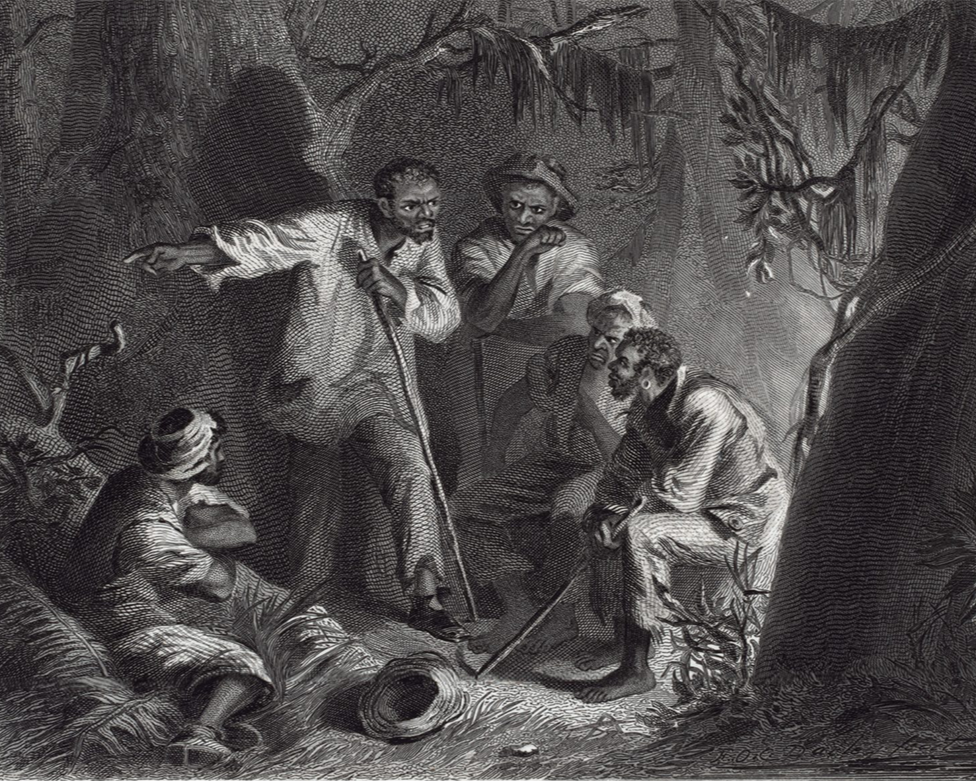
Nat Turner witnesses a solar eclipse lasting 1 hour and 57 minutes. Turner believes this to be a sign ‘from Heaven’ to begin an insurrection.
1831 July 4
Nat Turner had planned for his uprising to begin on the fourth; however, he was too ill to launch it.
1831 August 13
A day-long atmospheric phenomenon, during which the sun turned bluish-green, caused Nat Turner to see this as another sign from God to begin planning his revolt.
1831 August 14
Nat Turner preaches under a grape arbor next to Barnes Methodist Church. His followers wear something red to indicate their support. Inside the church, Reverend Richard Whitehead delivers a sermon.
1831 August 20
Nat Turner discusses his plans with two of his most trusted lieutenants, Hark and Henry, who were also bondsmen on the Travis farm. They discuss where they should meet to plan their revolt the following evening.
Note: The following timeline of the Insurrection is based on information gleaned from The Confessions of Nat Turner, edited by Thomas Ruffin Gray (1831), and The Southampton Insurrection by William Sidney Drewry (1900). From the times and distances noted in these sources, a reasonably accurate timeline can be developed using the rated speed of a horse (8 mph at canter) and the average walking speed of humans (2-3 mph).
1831 August 21
Midday — Hark, Henry, Nelson, Sam, Jack and Will assemble on an island in the midst of a reptile-invested swamp near Cabin Pond. There they made a fire to cook a shoat and sweet potatoes while drinking brandy awaiting the arrival of Nat Turner.
3:00PM — Nat Turner arrives; however, he does not initially mingle with his followers. Instead, he sits on a log a few yards away contemplating the insurrection.
4:00PM — Turner joins his followers and they begin planning their revolt.
10:00 PM — Turner and his followers begin their march toward the Travis Farm.
10:25 PM — Turner passes by the house of Giles Reese where his wife and children live.
11:50 PM — Arrive at the Travis House and enter the dwelling using a ladder. They burst into the Travis bedchamber. Nat attempts to kill Joseph Travis with a hatchet, but it bounces off his head. Will steps in and kills Mr. and Mrs. Travis. Putnam Moore and a young orphaned apprentice, Joel Westbrook, are also killed.
1831 August 22
12:00 AM — Nat Turner, using Captain Thomas Moore’s sword, trains his men in military drill using old muskets and fowling pieces found around the Travis house.
2:45 AM — Turner and his followers, including Austin, who joined the insurrectionists at the Travis Farm, train in military maneuvers. Will and Henry return to the Travis house and kill the Travis baby in its cradle by bashing its brains out. “Nits make lice,” Nat says at that moment. They begin their march toward the homes of other enslavers.
3:00 AM — The group reaches the home of Salathiel Francis. They kill him and shoot at his slave as he escapes.
3:30 AM — They pass Mrs. Harris's house and secure a new recruit, Joe Harris.
4:00 AM — Turner and his men reach the home of Mrs. Piety Reese. They kill her and her son and critically wound the farm manager, James Barmer.
5:15 AM — They attack Mrs. Elizabeth Turner's home. Mrs. Turner, her neighbor, Mrs. Newsome, and the overseer, Hartwell Peebles, are killed.
5:45 AM — Turner divides his command: Hark and six infantrymen head to the Henry Bryant House, and Turner, with nine men on horses, go to the Catherine Whitehead house. Turner and his men arrive at Mrs. Catherine Whitehead’s farm, where they kill her, her mother, her son (Richard), four daughters, and one grandchild. One daughter escapes into the swamp. Turner later admits that the Whitehead house is where he killed his only victim, Margaret Whitehead, using a fence rail. Harriet Whitehead was the only survivor, as Hubbard, one of the family’s older slaves, had assisted her. About this time, Hark and his men arrive after killing Henry Bryant and his family. Nat Turner confirmed that the infantry would go to the Howell Harris and Trajan Doyle houses, while Nat and the cavalry would head toward the Porter and Francis houses.
5:50AM — A portion of the group goes to Richard Porter’s house, but the Porter family had already fled.
6:10 AM — Nathaniel Francis had heard from an enslaved young boy from the Travis Farm that, “Some folks, some folks have killed all of the white folks.” Francis rides off to his sister Sally Francis’s home to confirm what the black youth had told him. Francis’s mother quickly follows a different path on foot to her daughter’s house. Sally and her husband, Benjamin Travis, and three others had been dead for several hours by the time Nathaniel Francis arrives there. A section of Turner’s command arrives at the Nathaniel Francis house, immediately killing the overseer, Henry Doyle, and Mr. Francis’s two nephews. Francis and his mother enter the home in search of Luvenia/Lavenia Francis. Nelson, one of the family’s slaves, has hidden her in an upstairs cubby.
6:40 AM — Mrs. John K. Williams and her child are killed in the lane leading to the Francis home.
6:50 AM — Luvenia/Lavenia Francis, eight months pregnant, is now lucid after passing out in the cubby where she hid from the insurgents. She goes downstairs and sees two female servants going through her clothes. One of them, a young girl named Charlotte, lunged at Luvenia with a knife, only to be stopped by Mrs. Frances’s lifelong servant, Easter. Nelson takes Luvenia into the woods toward the Travis place.
7:15 AM — Nat Turner and his men arrive at Peter Edwards’s house. The family was gone, confirming that news of the rebellion is spreading.
7:20 AM — Hearing screams and yelling from the Whitehead farm causes schoolteacher John ‘Choctaw’ Williams to ride there. After discovering the dead around him, he heads back to his farm, where a young enslaved boy runs up to him saying, “Your family has been killed at the Francis place.” Williams immediately rides to Murfreesboro, North Carolina, to alert the local militia, the Governor’s Guards, about the slave uprising.
8:00 AM — Turner arrives at Captain John Barrow’s home. Barrow had been warned of the insurrectionists’ approach by an enslaved person. Barrow discounted this, but becomes fully aware of the imminent danger when Mr. Drewry Bittle arrives and confirms the news. The captain urges his wife, Mary Vaughan Barrow, to flee; however, she delays. Captain Barrow is killed while making a furious defense so that his wife and child could escape.
9:00 AM — Nat and approximately 40 followers arrive at Captain Newitt Harris’s house. The family had already fled.
9:45 AM — The insurrectionists arrive at Levi Waller’s farm, where they kill Mrs. Waller, her young child, and ten students found in the Waller Schoolhouse.
10:30 AM — Turner's command arrives at William Williams’s home. Williams, his wife, and two young boys are killed.
11:40 AM — Nat Turner’s followers reach the home of Jacob Williams, where they kill Mrs. Williams, three of her children, Mrs. Caswell Worrell, wife of the overseer, her two children, and a visitor, Edward Drewry.
12:00 PM — Turner’s followers reach the home of Mrs. Rebecca Vaughan. The insurgents had already killed George Vaughan as he was riding to the Barrow House to pick up his sister and meet some fox hunters. They then set upon the house and kill Rebecca, her son Arthur, the overseer, and her niece, Anna Eliza Vaughan. Nat Turner later reported that he had approximately 60 supporters, all armed and mounted.
12:30 PM — While marching toward Jerusalem, they stop at James T. Parker’s farm. A few guards remain at the gate, while the rest proceed to the house. Instead of recruiting more followers, they drink brandy, and several pass out.
12: 45 PM — Nat Turner goes to the Parker house, where he finds his men disorganized due to heavy drinking. He attempts to reorganize them.
Militia units from Southampton County and Greensville County, Virginia, as well as Northampton County, North Carolina, begin arriving to track down the insurrectionists.
1:00 PM — Guards at the gate are attacked by the Southampton militia; they scatter. Turner’s men become disorganized, but soon, with help from Will, Hark, and Nelson, Nat’s followers are steadied. They have a brief skirmish in ‘Parker’s Field.’ Although the militiamen are initially repulsed, other militia units arrive, and the insurrectionists retreat.
2:30 PM — Realizing that the main bridge to Jerusalem is heavily guarded, Turner’s diminished force marches toward Cypress Bridge.
3:00 PM — Turner turns his men southward for a few miles and then north. They pass several farms, including ‘Thomaston.’ Thirteen-year-old George Thomas had organized his family’s escape just steps ahead of Turner’s command.
6:00 PM — Turner’s forces are reduced to 40 men. They spend the night at Ridley’s Quarter. Confusion during the night prompted many of Turner’s men to run away.
1831 August 23
5:50 AM — Turner, now with only 20 followers, breaks camp at dawn.
6:00 AM— Governor John Floyd had received news of the slave insurrection in Southampton County. He immediately called out the militia from Richmond, Norfolk, and Portsmouth. Captain John B. Richardson’s light artillery company and Captain Randolph Harrison are ordered to deliver 1,000 stands of arms to the Southampton and Sussex militia units. The same day, the mayor of Norfolk learns of the revolt and requests assistance for the local U.S. military resources.
6:15 AM — Turner attacks Dr. Simon Blunt's farm and is defeated by Blunt’s family, the overseer, two neighbors, and Blunt’s bondsmen. Hark, one of Turner’s primary lieutenants, is critically wounded during this brief engagement.
9:30 AM — Turner marches to Captain Newitt Harris’ house, where his followers are defeated. Will Francis is killed. Nat Turner escapes to a hiding place along Cabin Pond Road.
2:00 PM — Four of Turner’s followers – Curtis Ridley, Stephen Ridley, another man named Nat, and Jacob – remain with him. Turner sends Curtis and Stephen to find more recruits. John Clark Turner soon captures them. In desperation, Nat sends his last two compatriots to seek out other rebels. Nat Turner is left alone, a general without a command.
1831 August 24
Brigadier General Richard Eppes organizes a strong force, including Virginia militia and U.S. Army and Navy contingents, to patrol the countryside and capture those thought to be involved, and sometimes brutally kill the insurgents. The soldiers went through the county, stopping at some of the sites where Turner’s men had killed many enslavers.
James Hampden Pleasants, a member of Harrison’s Cavalry Troop and editor of the Constitutional Whig, would write about the atrocities committed by the insurgents. He found “whole families, fathers, mothers, daughters, sons, sucking babies, school children, butchered, thrown into heaps and left to be devoured by hogs and dogs or to putrefy on the spot.” These scenes prompted the militia units to seek revenge.
Although “General” Nat was nowhere to be found, several free Blacks who had supported the insurrection still endeavored to revive it. Billy Artis, Benjamin Haithcock, and Thomas Haithcock visit several farms to recruit. However, no enslaved person would join the rebellion because militia members were everywhere. Thomas Haithcock is soon captured. Billy Artis refuses to surrender. The militia found him dead with his hat on a stake and a pistol by his side.
The mayor of Norfolk requests federal forces to suppress the revolt. Lieutenant Colonel William Worth, three companies from Fort Monroe sent by Col. Robert House, and a naval contingent organized by Commodore Lewis Warrington, led by Commodore Stephen Elliot of USS Natchez, organized the request. Marines and bluejackets gathered from USS Warren and USS Natchez. The joint command travels by the packet steamer Hampton to Suffolk. Governor John Floyd dispatches more militia units and weapons to Southampton County.
1831 August 25
Federal forces arrive in Southampton County. Governor Floyd receives dispatches from Brigadier General Richard Eppes noting that he had received adequate troops.
1831 August 26
Brigadier General Eppes disbands artillery and infantry militia units and sends them home.
1831 August 27
Brigadier General William Brodnax sends Governor Floyd a dispatch stating that he has assumed command of the Brunswick County militia. The feared insurrection at Hick’s Ford in Greensville County never materialized.
1831 August 28
General Brodnax disbands the militia in Greensville County.
Brigadier General Richard Eppes orders members of the Virginia militia to end the excesses made against the ‘negro population or face military justice.
1831 August 31
Trials begin in the Court of Oyer and Terminer held at the Southampton County Courthouse in Jerusalem, Virginia. Daniel, owned by Levi Waller, is tried, convicted, and sentenced to be hanged.
1831 September 1
General Eppes reports to Governor Floyd that the militia has captured over 40 prisoners and that the insurrection is over.
Jack, a slave of Catherine Whitehead, is found guilty; however, the court makes a recommendation to the governor to commute the sentence. Andrew, another slave of Mrs. Whitehead’s, is also found guilty with a recommendation to commute the sentence. Moses, Thomas Barrow’s slave, is found guilty and sentenced to hang on 5 September 1831.
General Richard Eppes informs Governor Floyd that approximately 40 insurgents have been captured and that they are confined in the Southampton County Jail, to be turned over to the courts of that county.
1831 September 2
Davy, slave of Elizabeth Turner (deceased), is found guilty; Curtis, slave of Thomas Ridley, found guilty, is to be executed. Stephen, slave of Thomas Ridley, is found guilty and sentenced to hang. Isaac, slave of George N. Chalton, is found guilty; the Court recommends to the governor that his sentence be commuted to transportation.
1831 September 3
Sam, property of Nathaniel Francis, is found guilty and sentenced to hang.
1831 September 4
Governor Floyd writes to General Eppes to retain a sufficient guard at the Southampton Courthouse complex and to disband the rest of his forces.
1831 September 5
Jack, property of Joseph Travis, is tried. The court recommends that the governor commute his sentence to transportation.
Dred, property of Levi Waller, is found guilty; he is hanged on 12 September 1831.
Arnold, a free man of color, is examined by the court. The court states that the prisoner ought to be “discharged from further prosecution for the offense, which was counseling, advising, and conspiring to rebel.”
Tom, a slave owned by Catherine Whitehead’s estate, is discharged by the court as being innocent.
1831 September 6
Nathan, a slave of Benjamin Blunt, is found guilty and scheduled to hang on 12 September.
Nathan, Tom, and Davy, all property of Nathaniel Francis, are found guilty. The court recommends that the governor commute each sentence to transportation.
Hardy, property of Benjamin Edwards, is tried, and the court, for “good cause shown, doth suspend further proceedings on the case for the present.” The next day, the court finds the defendant guilty but recommends that the governor commute the sentence to a term of transportation.
1831 September 7
Sam, enslaved by James W. Parker, is found not guilty.
Jim, a bondsman of William Vaughan, is found not guilty.
Governor Floyd receives a letter from Colonel William A. Christian, commandant of the 27th Northampton Regiment, stating that ‘the negroes are in a state of insubordination and intend to create an insurrection.” Floyd sends arms and ammunition to Northampton and Accomack counties.
1831 September 8
Bob, Davy, Daniel, Temperance Parker, and Solomon Parker, all enslaved, are dismissed without charge from the proceedings.
1831 September 9
Hark, property of Joseph Travis, is found guilty and sentenced to hang.
Nelson, property of Jacob Williams, is found guilty and sentenced to hang.
Davy, property of Levi Walter, is found guilty and sentenced to hang.
As the prisoner Jack, property of William Reese, was not in attendance, “the court did suspend their proceedings in this case.”
Nat, property of Mary T. Barrow, is found guilty.
Governor Floyd notes that Prince William County was visited by emissaries from “free negroes” from the District of Columbia. “He is a Preacher. The whole of that massacre in Southampton is the work of these Preachers.”
1831 September 12
Thomas Haithcock, a free Black, could not be tried by the court and was imprisoned until the next session of the superior court.
1831 September 14
Floyd receives the record of “the trial of MiIsek, a negro in Greenville, for conspiracy.” Floyd notes: “The evidence was too feeble and therefore I have reprieved him for sale and transportation.”
1831 September 16
Governor Floyd receives the record of nine slaves condemned to be hanged in Sussex County. “One I have reprieved.”
1831 September 17
Governor Floyd issues an official proclamation offering a $500 reward for the capture of Nat Turner.
1831 September 19
Joe, a slave of John C. Turner, is found guilty and sentenced to hang on 26 September 1831.
Lucy, a slave previously owned by John T. Barrow, is found guilty and sentenced to hang on 26 September.
Matt, a slave owned by Thomas Ridley, is found not guilty.
Jim, a slave owned by Richard Porter, is found not guilty.
1831 September 20
Isham, property of Benjamin Edwards, is found guilty. The court recommends that the governor commute the sentence to transportation.
Berry Newsom, an indentured apprentice to Peter Edwards, and possibly a white man, is examined by the court. “After hearing the testimony…that the prisoner ought to be tried…at the next current superior court,” it is determined that Newsom be jailed until tried. (It is possible that Newsom was a white man, as he was arraigned by both his first and last name, and since it seems doubtful that there was a system of indenture that applied to people of African descent in Virginia in 1831.
Jack, a slave of Everett Bryant, is found not guilty.
Exum Artist, a free man of color, is examined. He is to be imprisoned until his trial before the next session of the Superior Court.
1831 September 21
Stephen, a slave owned by James Bell, is found not guilty and discharged.
1831 September 22
Jim, a slave owned by Samuel Champion, is found guilty and is to be hanged on 30 September. 1831.
Isaac, a slave owned by Samuel Champion, is found guilty and is to be hanged on 30 September.
Preston, a slave owned by Hannah Williamson, is found not guilty and discharged.
Frank, a slave owned by Solomon Parker, is found guilty; however, a request was made to the governor to commute the punishment to transportation.
1831 September 27
Governor Floyd receives a copy of the Liberator. He noted that the newspaper was printed in Boston, “with the express intention of inciting the slaves to rebellion and to murder the men, women, and children of those states.” Floyd believed the General Assembly must do something to punish those who plan and encourage slaves to rebel.
1831 September 28
Nelson, a slave owned by Benjamin Blunt, is found not guilty and discharged.
1831 October 17
Sam, Peter Edwards’s slave, is found guilty and sentenced to hang on November 4.
1831 October 18
Archer, a slave owned by Arthur G. Reese, is found not guilty.
Isham, a free man of color, is examined by the court. It is determined that the prisoner be tried by the Superior Court; he is remanded to jail.
Moses, a slave of Joseph Travis, is found guilty; however, it is recommended that the governor commute the sentence to transportation.
1831 October 30
12:00 Noon — Benjamin Phipps captures Nat Turner.
1831 October 30-31
Nat Turner is kept prisoner by Benjamin Phipps on or near Peter Edwards’s farm.
1831 October 31
12:00 Noon — Nat Turner is surrendered by Phipps to Edward Butts, Deputy Sheriff of Southampton County, and placed in the county jail.
1831 November 1-3
Nat Turner is interviewed by lawyer Thomas Ruffin Gray in his jail cell. It is believed that he dictated his ‘Confessions’ to Gray. Gray returned to his home, ‘Seven Gables,’ near the courthouse, to transcribe the manuscript.
1831 November 3
Governor Floyd receives news of Nat Turner’s capture.
1831 November 5
Nat Turner, Putman Moore’s slave, is tried and found guilty. The court acknowledges that “The Confessions of Nat Turner,” as transcribed by Thomas Ruffin Gray, is an authentic account of the Southampton Insurrection.
1831 November 10
Thomas Gray has “The Confessions of Nat Turner” copyrighted by Edward J. Lee, Clerk of Washington, District of Columbia.
1831 November 11
12:00 Noon — Nat Turner is hanged. The executioner is Deputy Sheriff Edward Butts.
1831 November 17
The Constitutional Whig urges the General Assembly into action, stating, “Everyman feels the force of Mr. Jefferson’s metaphor that we have the wolf by the ears, and its increasing truth. There is a general acknowledgement that something ought to, and must be done” about the evil menace of slavery.
1831 November 21
The final trial of an enslaved person accused of being involved with the Southampton Insurrection occurs. Ben, the 50th enslaved person tried since the beginning of the insurrectionists’ court cases, is found guilty. The estate of his enslaver, Benjamin Blunt, is reimbursed $400.
Governor Floyd wrote in his diary, “There are still demands for arms in the lower county. I could not have believed there was half the fear amongst the people of the lower county in respect to their slaves. Before I leave this Government, I will have contrived to have a law gradually abolishing slavery in the State, or at all events to begin the work by prohibiting slavery on the West side of the Blue Ridge Mountains.”
1831 December 2
The Richmond Enquirer puts forth the notion of a division of Virginia between east and west of the Blue Ridge Mountains. Its editor, Thomas Ritchie, wrote, “We can find no substantial reasons for continuing this connection between counties geographically divided by nature, inhabited by people of different origin, habits, and principles, having no intercourse, and whose legislative history from its commencement, displays incessant disagreement.”
1831 December 6
The governor’s message to the Senate and House of Delegates discussed actions to be taken to resolve issues associated with the Southampton Insurrection. First, he thanked everyone who worked to suppress the revolt. He told those assembled “that negro preachers” had been the cause of the rebellion, and Northern abolitionists had furthered the flames of revolt by producing and spreading “inflammatory pamphlets.” Floyd believed the existence of free Blacks in the state stirred anger in the enslaved.
Floyd stressed that free Blacks were dangerous and should be removed from the state. He hoped that the General Assembly would revise slave laws “to preserve in due subordination the slave population of the state.” What Floyd did not directly say was that Virginia should adopt a viable system of emancipation to enhance economic well-being and foster a progressive outlook, thereby strengthening the commonwealth. Nevertheless, he was working behind the scenes with his allies from the western part of the state to discover a suitable path forward.
1831 December 12
The House of Delegates creates a thirteen-man Select Committee to respond to the governor’s guidance and instructions, as well as various petitions filed by the public. The House furthermore assigned the Select Committee to study the possibility of colonizing free Blacks in Liberia. Delegate William H. Brodnax of Dinwiddie County is named chair. A brigadier general in the state militia, he had helped suppress the Southampton Insurrection.
1831 December 14
The Society of Friends (Quakers) of Charles City County submits a petition that the General Assembly consider slavery “an evil in our Country and that it should be abolished.” Select Committee member Delegate William H. Roane of Hanover County, and grandson of Patrick Henry, puts forward two petitions: the Quaker request calling for the emancipation of enslaved people of African descent, and the other, from Hanover County, asking for voluntary emancipation and colonization. Conservative delegate William Goode sought to block the reading; however, Chairman Brodnax insisted that it be read and debated. Brodnax knew that other states had already eradicated slavery, and why should Virginia not follow this action plan? “They did not,” he added, “object to touching the subject, but met it boldly, and are reaping the measures. Does any man doubt that slavery is an evil?”
1831 December 16
A petition from Buckingham County is received, suggesting emancipation and colonization because the petitioners feared that the state’s Black population was growing too fast and the white population was not increasing at all. It was believed this situation would leave Virginia under the threat of control by the enslaved.
1831 December 17
The question arose as to how to effectively address the presence of free Black people in Virginia. Several petitions are received, generally urging that the commonwealth appropriate funds to send all free Blacks to Liberia. Many suggested Virginia should purchase slaves and transport them elsewhere, while others stated that the existence of free Blacks in Virginia supported “dangerous intrigues with our slaves.”
Thomas Miller of Powhatan County suggests that the correspondence between Governor James Monroe and President Thomas Jefferson about the slave conspiracies of Gabriel (1800) and Sancho (1802) be reviewed, as they had discussed a plan to colonize the state’s entire Black population.
1831 December 20
The slave Ben is hanged as a result of his participation in the Southampton Insurrection.
1831 December 26
Governor Floyd writes in his diary: “The question of the gradual abolition of slavery begins to be mooted. The Eastern members, meaning those east of the Blue Ridge Mountains, wish to avoid the discussion, but it must come if I can influence my friends in the Assembly to bring it on. I will not rest until slavery is abolished in Virginia.”
1831 December 30
A Loudoun County petition puts forth that Virginia should begin gradual emancipation with the final result being “the removal of the entire colored population.”
-
Several speeches are made in support of abolition, focusing on the fear of future slave revolts, the inherent evils of slavery, and how it has caused Virginia to trail behind other states economically.
1832 January 2
Charles J. Faulkner resolves that the committee recommend a plan for gradual emancipation while guaranteeing enslavers the right to either maintain their current enslaved work force or receive compensation for the removal of their slaves.
1832 January 7
Thomas Richie of the Richmond Enquirer issues the most strident plea to handle the problem of slavery: “It is probable from what we hear that the Committee on colored population will report some plan for getting rid of free people of color. But is this all that can be done? Are we forever to suffer the greatest evil, which can scourge our land, not only to remain, but increase its dimensions?”
1832 January 10
Chairman Brodnax reports that the committee is focused on two themes: the removal of free Blacks and the gradual extinction of slavery.
1832 January 11
The conservative and pro-slavery delegate William Goode strives to block any discussion of the “slavery issue.” Nevertheless, Delegate Thomas Jefferson Randolph of Albemarle County (and Thomas Jefferson’s grandson) believed that the General Assembly should create legislation that would submit to a public vote a gradual emancipation and colonization plan.
Governor Floyd is pleased with the General Assembly's decision to open the galleries during the slavery debate, which would allow the public and media to hear the pro- and con-arguments about slavery within the commonwealth. Floyd believed this participation would sway public opinion to gradual emancipation.
Several speeches were made in support of abolition, focusing on the fear of future slave revolts, the inherent evils of slavery, and how it caused Virginia to trail behind other states economically.
1832 January 12
Delegate James H. Gholson responds to the view of gradual emancipation with an appeal to the rights of property owners, citing the Fifth Amendment, which prohibits the government from taking private property for public use without compensation. Gholson goes on to cite “that the slaves of Virginia were as happy a laboring class as exists upon the habitable globe. They are content today and have no care or anxiety for tomorrow.” Despite the recent Southampton Insurrection, he argued that slavery was a positive good.
1832 January 16
After much discussion as to the merits of slavery or the need for emancipation to enhance Virginia’s economic, social, and moral standing, William Preston makes an amendment that it was “expedient for the present to make any legislative enactments for the abolition of slavery.” There were still serious arguments about the morality and economic rewards of slavery, the workability of gradual emancipation, the costs entailed in transporting free Blacks and former slaves to Liberia or elsewhere, the limits of property rights, and Virginia’s economic future. If Virginia did take the questionable step toward abolition, it would create a domino effect throughout the Upper South.
1832 January 25
The House of Delegates votes and rejects the Select Committee’s concepts. The House added a preamble to the committee’s report. Archibald Bryce Jr. of Goochland County wrote: “Profoundly sensible of the great evils arising from the condition of the coloured population of the Commonwealth: induced by humanity, as well as policy, to an immediate effort for the removal in the first place, as well of those who are now free, as of such hereafter become free: believing that this effort, while it is in just accordance with the sentiment of the community on the subject, will absorb all our present means; and that a further action for the removal of the slaves should await a more finite development of public opinion.”
1832 March 15
After some debate, the Virginia General Assembly passes new slave codes that increased limitations on slaves, free Blacks, and mulattos. The codes read:
No slave, free negro, or mulatto, whether he shall have been ordained or licensed, or otherwise shall hereafter undertake to preach, exhort, or conduct, or hold any assembly or meeting, for religious or other purposes, either in the daytime or night. Any offender would receive no less than thirty-nine lashes.
Any slave, free negro, or mulatto, shall attend any preaching, meeting, or other assembly held for religious purposes, or other instruction, conducted by any slave, free negro or mulatto preacher ordained or otherwise; and any slave who shall hereafter attend any preaching in the night time, unless conducted by a white minister, without permission of their owner shall be punished by no more than thirty-nine lashes.
(This code did not preclude masters or owners of slaves or any white person to whom any free negro or mulatto is bound to attend religious services accompanied by a white person or family.)
No free negro or mulatto is able to purchase or otherwise acquire permanent ownership, except by descent, to any slave, other than his or her husband, wife, or children.
No freed Black or mulatto shall keep or possess any firelock of any kind, any military weapon, or any powder or lead.
No slave, free Black, or mulatto will be permitted to sell, give, or otherwise dispose of any ardent or spirituous liquor.
If any slave, free Black, or mulatto willfully and maliciously assaults and beats any white person with the intention of killing such white person, they will be deemed guilty of a felony and suffer execution.
If any person writes, prints, or causes to be written or printed, any book, pamphlet, or other writing, advising persons of color within this state to make insurrection, or to rebel, or shall knowingly circulate, or cause to be circulated, any book, pamphlet, or other writing, writen or printed, advising persons of color in this commonwealth to commit insurrection or rebellion; such person, if a slave, free negro, or mulatto, shall, on conviction be punished for the first offense not exceeding thirty-nine lashes; and for the second offense, shall be deemed a felony and shall be punished with death without the benefit of clergy; and if the person so offending be a white person, he or she shall be punished by a fee of not less than one hundred nor more than one thousand dollars.
Riots, routs, unlawful assemblies, trespasses, and speeches by free negroes or mulattos shall be punished with no more than thirty-nine lashes.
If any free negro or mulatto shall commit simple larceny of any money, bank notes, goods, chattels, or other thing of value of twenty dollars or less, to shall be punished by thirty-nine lashes.
Free negroes and mulattos shall hereinafter be prosecuted, tried, convicted, and punished for any felony by justices in the same manner as slaves are now prosecuted, tried, convicted, and punished.
These new slave codes also included details on how to conduct trials and administer punishments. The January 26 rejection of the gradual emancipation of the enslaved and the establishment of new, harsh slave codes, which included strict control of free Blacks and mulattos, were major defeats for Governor John Floyd. His dream of charting a path for gradual emancipation throughout the commonwealth failed despite the press and public support for action. The close vote, 73 to 58, signified that the commonwealth’s attitudes toward slavery were changing, and the thoughts of gradual emancipation were becoming more popular. Once freed, the formerly enslaved people, along with free Blacks, were to be transported to Liberia or some other location.
These statements were a viable attempt to end slavery; however, they also helped to reinforce the tremendous bigotry that then existed (and continued well into the 20th century). The General Assembly could not develop any significant move toward anti-slavery policies due to the strength of the slavocracy in the Piedmont and Tidewater regions. They could not envision Virginia without a slave-based economy, despite all of the economic merits that abolition would bring. Many also realized that if Virginia ended slavery, other slave states like Maryland, Delaware, and Missouri would follow, thus breaking the South’s control over Congress. Antislavery discussions that began in the wake of Nat Turner’s Rebellion turned into harsher slave codes.
The 1831-1832 General Assembly debates were the South’s final major attempt to end slavery. Eastern Virginia now turned more strongly against abolitionism, and it associated anti-slavery voices with Northern agitation.
1832 April 4
Isham Turner, a free man of color, is found innocent of any involvement in the Southampton Insurrection.
Thomas Haithcock, a free man of color, is tried and found innocent.
1832 April 5
Berry Newsom, a freeman of color, was tried and found guilty of insurrection and murder.
1832 April 7
Berry Newsom was sentenced to be executed by hanging.
1832 April 15
Exum Artist tried and acquitted
1832 May 11
Barry Newsum is executed in Richmond, Virginia.
-
The American Anti-Slavery Society is founded in New York City, NY.
-
1835 July 29
The Lynch Men, a pro-slavery group, break into the post office in Charleston, SC, and take and destroy a mail sack filled with publications of the American Anti-Slavery Society. The pamphlets and newspapers are burned in a bonfire attended by more than 2,000 people.
-
Robert Purvis organizes the Vigilance Committee to aid and assist fugitive slaves. Purvis is referred to as the “President of the Underground Railroad.”
-
Authentic Anecdotes of American Slavery by Lydia Maria Child is published. Child was recruited to the abolitionist cause by William Lloyd Garrison. Her book is a series of stories from enslavers and other white citizens. Child also wrote An Appeal in Favor of that class of Americans called Africans; she later served as editor for the National Anti-Slavery Standard.
1838 May 17
Angelina Grimké delivers a lecture at a racially integrated abolitionist meeting at Philadelphia's Pennsylvania Hall. Her message is critical not only of Southern slaveholders but also of Northerners who support slavery by purchasing slave-produced products; thereby, exploiting them with economic exchanges with the slavocracy. Rioters form outside the hall, and Grimke leads the meeting’s attendees out arm-in-arm. The mob then burns Pennsylvania Hall down. (Also see 1836, Grimké.)
-
The British and Foreign Anti-Slavery Society is founded in London.
Pope Gregory XVI condemns slavery and the slave trade.
1839 July 2
La Amistad Affair
Fifty-three freedmen are illegally seized from the British colony of Sierra Leone and are transported to Cuba by Portuguese slave traders along with 500 Africans destined for slavery. Once in Cuba, the 53 freedmen are taken aboard the Spanish schooner La Amistad. The ship left Havana; however, soon afterward, Joseph Cinque (also known as Senge Pieh) escaped and freed the others. As they moved to take over the ship, two captives were killed, and two escaped in a ship’s boat. The ship’s cook, Celestino, and the captain, Ramon Ferrer, are kept to sail the schooner back to Africa.
Instead, the Spanish sailors sailed to Long Island, New York, where they landed on 26 August 1839. Spanish authorities demanded the return of the slaves and the ship. The issue was based on those Sierra Leone citizens who were illegally taken from their homes by slave traders in violation of the international agreements outlawing the international slave trade.
The case was referred to the U.S. Supreme Court for judgment. Former U.S. President and Massachusetts Congressman John Quincy Adams defended the Africans. On March 9, 1841, the Supreme Court ruled that the captives were illegally taken from their homes in Sierra Leone and, consequently, free. Northern abolitionists raised the money required to send these people back to Africa.
-
The Liberty Party is founded on an abolitionist platform. Their candidate for President is anti-slavery activist James G. Birney, a former slaveowner from Alabama and Kentucky who manumitted his enslaved people and eventually moved to Cincinnati, Ohio. There, he establishes an anti-slavery newspaper, The Philanthropist. (In 1837, he became an officer of the American Anti-Slavery Society, and he was already a member of the American Colonization Society.) Birney was the Party’s candidate again in 1844.
-
1841 November 7
Creole Mutiny
Madison Washington and 18 other enslaved persons aboard the merchant slave ship Creole overwhelm and kill the slave trader John R. Hewell. They force the remaining crew to sail to the British colony of the Bahamas. There were 135 enslaved persons aboard being transported from Hampton Roads, Virginia, to New Orleans. As soon as Creole reached Nassau, Bahamas, the British authorities declared 128 people free because Great Britain had ended slavery in all of its possessions in August 1834. The United States sought to have the slaves returned; however, the British government refused.
There were similar cases, such as Comet (1830) and Encomium (1833), which entered British waters due to storms. Great Britain freed the slaves on board, but compensated their owners. These events caused tensions between the United States and Great Britain; however, they were soon resolved by arbitration.
The Creole Mutiny was the most successful revolt in American history. British colonial authorities eventually freed about 450 slaves during this era.
-
1842 November 15
Cherokee Slave Revolt
The Cherokee Nation had practiced slavery since the 18th century. Slavery was codified by the Cherokees in 1819. When forced to move to Indian Territory (Oklahoma) during the Trail of Tears, they took their slaves with them.
The Cherokee Slave Revolt begins when 25 enslaved Blacks, mainly from the Joseph Vann plantation, locked their enslavers in their homes. Their goal was to escape to Mexico, where slavery had been illegal since 1829. The bondsmen stole horses, mules, weapons, ammunition, and supplies for their march south. Slaves from the Creek and Choctaw nations soon joined them. As the runaways neared the Canadian River, they were attacked by Creek and Cherokee militia. The ensuing battle resulted in the deaths of two fugitives; twelve were captured. The militia returned to Webber Falls, Indian Territory, for reinforcements. Fifteen miles west of the Canadian River, the refugees came across two slave catchers: a white man named James Edwards and a Delaware Indian named Billy Wilson with eight recaptured slaves. The runaways killed the two slave catchers, added the released people to their party, and headed westward.
1842 November 17
Fearing a much larger revolt, the National Council of the Cherokees authorizes the Cherokee Lighthorse Militia, commanded by Captain John Drew, to find and return the escapees.
1842 November 26
Fugitive slaves are captured and returned to Webber Falls. Five of these bondsmen are executed for killing the slave catchers.
-
Life of Frederick Douglass, an American Slave, written by Douglass, is published. This is a compelling account of the inequalities of slavery and how education enabled Douglass to escape slavery and become a leading abolitionist. Douglass lectured in Europe, served as editor of the North Star, and continued to advocate for civil rights after the Civil War.
-
The autobiography, William N. Brown, a Fugitive Slave, is published. Brown was born to a white enslaver and a Black enslaved mother. He describes the hypocrisy of Christian slaveowners and the cruelties of slavery. He was the first African American to publish a novel, play, and travel book.
-
The United States’ victory in the Mexican War adds vast new western territories. It became a flash point for the advancement of slavery as well as methods to restrict slavery’s expansion.
-
Harriet Tubman escapes from slavery and becomes a major conductor on the Underground Railroad.
-
Following the 1850 Fugitive Slave Law, John ‘Fed’ Brown, a runaway, fearing recapture in Canada, sails to Great Britain.
-
Harriet Beecher Stowe’s Uncle Tom’s Cabin; or, Life Among The Lowly is published in serial form. This influential story helps widen the divide between North and South as it pushes forward the need to abolish slavery.
-
The Sword and the Destaff: Fair, Fat and Forty by William Gilmore Simms is published. Several books were published after Uncle Tom’s Cabin that try to counter Harriet Beecher Stowe’s view of slavery. Simms’s volume is an extended defense of the institution of slavery. A prolific author, Simms is referred to as the South’s James Fenimore Cooper. He was an ardent supporter of slavery, states' rights, and secessionism.
Aunt Phyllis’s Cabin by Mary Henderson Eastman is published and considered one of the best examples of anti-Uncle Tom literature.
-
Twelve Years A Slave by Solomon Northrup, and edited by David Wilson, is published. The story is about Northrup, a free Black who is kidnapped into slavery. The book details how his various owners, ranging from kind to sadistic, treated him and how he was eventually returned to freedom by a Canadian abolitionist.
Philip J. Cozans’s Little Eva: The Flower Of The South is published – the only anti-Uncle Tom work to be printed as children’s literature.
-
Publication of The Planter’s Northern Bride by Carolina Lee Hentz is written in response to Uncle Tom’s Cabin. Hentz criticizes abolitionism. The story is told through the eyes of an abolitionist's daughter who marries a Southern planter. She soon realizes that enslavement is a benign and kind system and best for those slaves of African descent.
-
Fugitive slave John Brown dictated history to Louis Alexis Chamerovzow of the British and Foreign Anti-Slavery Society. Brown’s memoir was published as Slave Life In Georgia: A Narrative of the Life, Sufferings, and Escape of John Brown, A Fugitive Slave, Now in England. This volume is one of over two dozen books written in the Antebellum era to describe the conditions and evils of slavery.
1855 Spring
Abolitionist John Brown becomes an ardent anti-slavery advocate and befriends noted abolitionists, including Frederick Douglass and Sojourner Truth. Brown soon had become radicalized and moved with five of his sons – John Jr., Jason, Owen, Frederick, and Salmon – and a wagon loaded with arms and ammunition to Kansas. In essence, a Civil War existed in Kansas between pro-slavery supporters and abolitionists. John Brown was determined to cleanse the Kansas soil by desecrating its enslavers.
1856 May 21
Pro-slavery forces sack the town of Lawrence, Kansas. This, along with Senator Charles Sumner being caned by Congressman Preston Brooks the next day, prompts abolitionist John Brown to seek revenge.
-
1856 May 24-25
Pottawatomie Massacre
John Brown, his sons, and other anti-slavery settlers attack houses near Pottawatomie Creek, Kansas, killing five “professional slave hunters and militant pro-slavery” settlers. Brown had inflamed both pro- and anti-slavery settlers in Kansas. Two other pitched battles, the Battle of Black Jack Palmyra on 2 June 1856 and the Battle of Osawatomie on 30 August 1856, were fought in Kansas.
1856 September 14
A large engagement is advertised by Kansas Governor John W. Geary. Brown and his sons left Kansas forever and returned to the East. Believing himself an “instrument of God,” and determined to put an end to chattel slavery, Brown began raising money to underwrite his plan to create a slave rebellion in Virginia. The result would be that he could establish a slave republic in Virginia.
-
1859 July 3
John Brown arrives in Harpers Ferry, Virginia, renting a farmhouse across the Potomac River in Maryland. He approached individuals like Harriet Tubman, Frederick Douglass, and William Lloyd Garrison to join his cause; however, many believed his plan was foolhardy and bound to fail. Brown had raised funds to defray his expenses and to secure 200 Sharps rifles and 1,000 pikes. Yet he could only recruit 21 men to support his cause. His goal was to capture the 100,000 rifles held in the arsenal and distribute them to slaves. They would then march south, gathering more supporters as they traveled.
1859 October 16
John Brown and his followers capture the armory and round up hostages, including the great-grand nephew of George Washington, Colonel Lewis Washington. Brown’s men cut the telegraph line to Washington, DC. However, Brown allows a train to pass through Harpers Ferry and, at the next station sends telegrams to Washington, DC, and Richmond, Virginia.
1859 October 17
A skirmish erupts between the local militia. John Brown moves his men and hostages into the arsenal’s firehouse, known as “John Brown’s Fort.”
1859 October 18
A force of U.S. Marines under the overall command of Colonel Robert E. Lee is sent to Harpers Ferry. Lee orders Lt. J.E.B. Stuart to call for Brown to surrender. Brown replies, “No, I prefer to die here.” The firehouse is rushed by the Marines with a battering ram. Brown is wounded and captured.
Later that day, Virginia Governor Henry A. Wise, Virginia State Senator James Mason, and Ohio Congressman Clement Vallandigham questioned Brown about his inciting a slave rebellion, treason, and murder.
1859 October 26
John Brown’s trial begins in Charlestown, Virginia.
1859 November 2
John Brown is found guilty and sentenced to be executed.
1859 December 2
John Brown is hanged. He had wanted to be a martyr and felt that his death would ring the bell for freedom everywhere. His last words were, “I, John Brown, am now quite certain that the crimes of this guilty hand will never be purged away, but with blood. I had, as I now think, vainly flattered myself that without very much bloodshed, it might be done.”
John Brown’s execution was just 28 years after the 1831 Southampton Insurrection, and 27 years since Virginia debated slavery and failed to abolish it. It had been only 300 years since the first Africans arrived in English-speaking North America, and 265 years since slavery was instituted in Virginia. Sadly, it was just 18 months before the Civil War broke the United States apart. Exactly 1,126 days after Brown’s execution, the Emancipation Proclamation was issued on January 1, 1863. By the end of the war, slavery had ended.